 EN
EN
How to Choose a Dental Chair: A Distributor's Technical Buying Guide
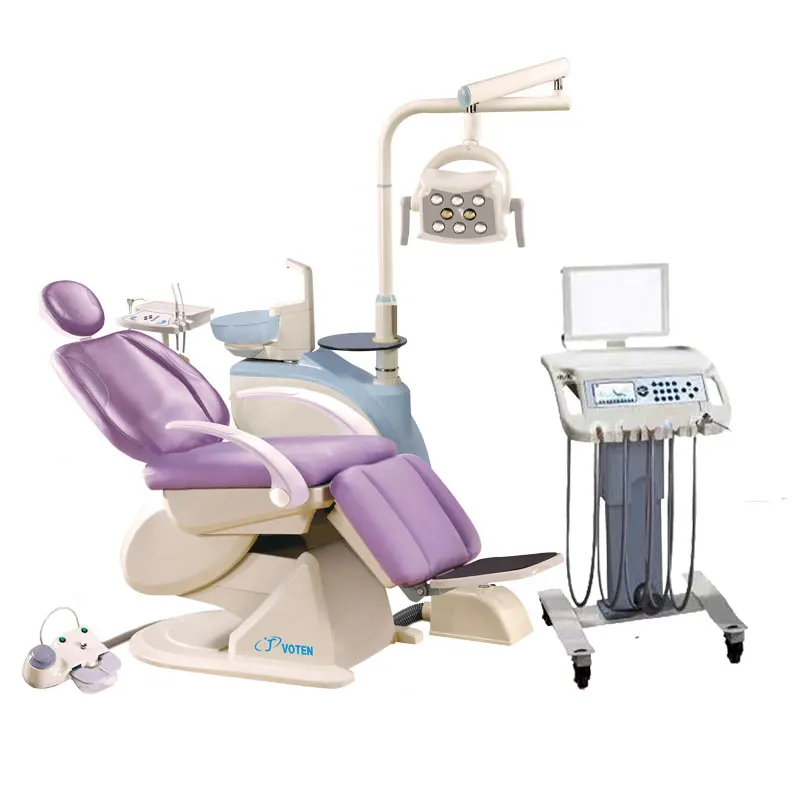
Most buying guides for dental chairs are written for dentists choosing one chair for their own surgery. This one is written for the other side of the transaction — the distributor, dealer or importer who has to commit to a container, hold stock, install the units and then support them for the next ten years. The specification decisions that matter to you are not always the ones that matter to a single end user.
The short version: a dental chair is not really one product. It is a chair, a delivery system, a light, a spittoon assembly, a suction circuit and a control board, sourced and assembled together. Most warranty problems in export markets come from three or four of those sub-assemblies, not from the chair frame. Spend your evaluation time there.
Start with the delivery system layout, not the chair
The delivery system — the arm or cart holding the handpiece tubing, syringe and scaler — determines how the chair is used, and it is the hardest thing to change after the container lands. There are three common layouts:
- Over-the-patient (continental / swing-arm). The instrument tray hangs on an arm above the patient's chest. Popular in Europe and much of Latin America. Instruments are in the dentist's line of sight, but the tray is visible to the patient, which some clinics dislike for nervous or paediatric patients.
- Side delivery (chair-mounted, right or left). The tray is mounted beside the chair on a pivot. This is the most widely accepted layout across Africa, Southeast Asia and the Middle East, and it is usually the safest default for a general stock order.
- Cart / mobile delivery. A free-standing trolley. More expensive per unit and takes more floor space, but flexible in clinics that move equipment between rooms or run mobile outreach.
Two practical points. First, ask whether the chair is convertible — some frames accept either a swing arm or a side-mount bracket on the same base, which means you can carry one chassis in stock and configure at installation. That single feature can cut your SKU count in half. Second, ask about left-handed configuration. It is a small share of demand, perhaps one clinic in twenty, but it is demand your competitor probably cannot serve at short notice.
Hydraulic or electric? Ask about the motor, not the label
Entry-level chairs use a hydraulic pump; mid and upper chairs use one or more linear electric actuators. Electric is quieter, gives finer positioning and avoids the risk of hydraulic fluid weeping onto upholstery in hot climates. But "electric" on a datasheet tells you very little on its own. The questions that predict field reliability are:
- How many motors? A single-motor chair tilts the whole frame. A two-motor chair moves backrest and seat independently, which is what makes true Trendelenburg and a flat treatment position possible.
- What is the rated load, and at what duty cycle? A chair rated to 135 kg static may not be rated for that load through repeated cycling. For markets where average patient weight is high, ask for the cycle-tested figure.
- Whose actuator is it? If the actuator is a branded unit, replacements are obtainable anywhere. If it is a house-brand part, you depend entirely on the factory — which is workable, but only if the spare-parts commitment below is in writing.
- Is there a mechanical or manual release? When power fails with a patient reclined, a backup path to raise the backrest is not a luxury.
Suction: the single biggest source of installation surprises
Suction is where dental chairs most often fail to match the clinic they are being installed into. There are two circuits, and they are not interchangeable:
- Wet (wet-ring) suction uses a water-sealed pump. Cheaper to buy, uses water continuously, and drains water plus aspirate together.
- Dry suction separates air from liquid at the chair and needs a different plumbing arrangement, but uses far less water — which matters in markets where water supply is intermittent or metered.
Before you order, confirm three things with the factory: the hose diameters on the chair side, whether the unit is supplied with a saliva ejector only or with a high-volume evacuator as well, and whether the chair's drain requires a floor outlet or can be plumbed to a wall trap. A chair that assumes a floor drain will cause installation delays in any clinic in a rented upper-floor unit — which, in most urban markets, is most clinics.
Compressor pairing: do the maths before you quote
Dental chairs are frequently sold as a package with an oil-free compressor, and the pairing is often wrong. The working figures to check:
| Parameter | What to confirm | Why it matters |
|---|---|---|
| Air flow (L/min) | Free air delivery, not displacement | Displacement figures overstate usable output, sometimes by 30–40% |
| Working pressure | Typically 0.6–0.8 MPa at the handpiece | Low pressure causes weak turbine cutting, the most common "the chair is faulty" complaint |
| Tank volume | Matched to number of chairs served | An undersized tank means the motor cycles constantly and burns out |
| Noise level (dB) | Measured at 1 m | Compressors are often installed in the same room in small clinics |
| Air dryer | Fitted or optional | In humid coastal markets, moisture in the line destroys handpieces |
A single dental chair in normal use is usually served comfortably by a compressor in the 24–50 L tank range; two or three chairs need a genuinely larger unit, not the same model with a bigger badge. If you serve tropical or coastal clinics, specify the dryer as standard rather than as an upsell — the warranty claims it prevents will cost you more than the option ever earns. You can see the range VOTEN supplies on our dental air compressor pages.
Electrical specification: the detail that strands containers
This one is simple but is responsible for a surprising share of disputes. Confirm in writing, on the proforma invoice:
- Voltage and frequency. 110V/60Hz, 220V/50Hz and 220V/60Hz are all in use across the markets we ship to. A 50Hz motor run at 60Hz will run, but hotter and faster; it is not a substitution you should accept silently.
- Plug type. Type G for Nigeria, Kenya and much of East Africa; Type A/B for Mexico and most of Central America; Type C/F, I or others elsewhere. Getting this right costs the factory nothing at build time and costs you an adapter per unit if it is wrong.
- Voltage stability tolerance. In markets with unstable mains, ask what range the control board tolerates and whether a stabiliser is recommended. Many chair control boards die from surge, not from wear.
Upholstery and finish for hot, humid and high-UV markets
Upholstery is the part of the chair the end customer touches, and the part that fails first in the field. Ask for the material designation — not just "PU leather" — and specifically whether it is rated for the disinfectants used locally. Alcohol- and chlorine-based wipes degrade cheap polyurethane within a year; seams split, and the clinic blames the chair. Where clinics disinfect aggressively, a heavier-grade or seamless-moulded cushion is worth the price difference.
Two more small things that matter more than they sound: whether the cushion set is available as a separate spare part in the colours you sell, and whether the colour range is stable across production batches. A dealer who can replace one cushion in the original colour three years later looks very different from one who cannot.
Spare parts, documentation and service — put it in the contract
This is where a distributor relationship either works or does not. Before you place a first order, get written answers to:
- How long will spare parts be available for this model after it is discontinued? (Five years is a reasonable ask.)
- Which parts are treated as consumables, and what is the warranty period for the chair, the control board, the motors and the upholstery — separately?
- Will the factory supply a spare-parts kit with the first container, and at what price? Shipping one control board with the container costs almost nothing; air-freighting one later costs more than the margin on the unit.
- Are service manuals, wiring diagrams and exploded parts diagrams provided, and in which language?
- Is there installation and troubleshooting support for your technicians — video call, written guides, or training?
A factory that answers these precisely is telling you something useful about how it operates. A factory that answers them vaguely is telling you something useful too.
Certificates: know what you actually need for your market
Ask for copies of the certificates, with the issuing body and expiry visible, and check that the certificate covers the specific model you are buying rather than a different model from the same factory. Typical documents for dental equipment out of China include ISO 13485 for the quality system and CE marking where the destination market recognises it. Which of these your customs authority and health regulator actually require depends entirely on the destination — Nigeria's NAFDAC, Mexico's COFEPRIS, Saudi Arabia's SFDA and the Philippine FDA all ask for different combinations. We cover two of those in detail in our country import guides.
Container loading: the maths that sets your landed cost
Landed cost per chair is decided as much by packing as by unit price. Ask for the packing data and run it yourself:
- Carton dimensions and gross weight per chair, and whether the chair ships knocked down or assembled.
- How many units fit in a 20ft and a 40ft HQ container, and whether the factory's figure assumes stacking.
- Whether the compressor, stool and accessories ship in the same carton or separately — they change the cube significantly.
A chair that is $60 cheaper but loads twelve fewer units to a 40ft container is not cheaper. Ask for the packing list before you compare quotes, not after.
A short pre-order checklist
| Area | Confirm before you pay the deposit |
|---|---|
| Configuration | Delivery layout, left/right hand, convertible frame |
| Motors | Number, rated load, cycle rating, manual release |
| Suction | Wet or dry, hose sizes, floor or wall drain |
| Compressor | Free air delivery, tank size, dryer fitted |
| Electrical | Voltage, frequency, plug type, surge tolerance |
| Upholstery | Material grade, disinfectant compatibility, spare cushion availability |
| After-sales | Parts availability period, spare kit with first container, manuals |
| Documents | Certificates covering this model, packing list, loading plan |
Talk to us with your specification in hand
VOTEN Medical manufactures dental chairs and dental unit packages in Foshan, China, and supplies distributors across South America, Africa, Southeast Asia and the Middle East. If you send us the configuration you need — market, voltage, delivery layout, quantity — we will come back with specification sheets, packing data and distributor pricing rather than a generic catalogue.
Browse the range on our dental chair and products pages, or send us your requirement and we will reply within one working day.